
Medical & Developmental Embryology • Intrauterine Morphogenesis & Human Origins
Human Embryology in the Holy Quran: The Step-by-Step Architecture of Intrauterine Life
A comprehensive, easy-to-understand breakdown of the Quranic stages of human development—from fertilization (Nutfah Amshaj), genetic programming (Taqdir), and implantation (Harth), to the clinging leech-like embryo ('Alaqah), somite segmentation (Mudghah), sequential bone and muscle clothing ('Izam & Lahm), and the three anatomical veils of darkness (Zulumat Thalaath)—reviewed alongside 21st-century developmental biology.
وَلَقَدْ خَلَقْنَا الْإِنسَانَ مِن سُلَالَةٍ مِّن طِينٍ ثُمَّ جَعَلْنَاهُ نُطْفَةً فِي قَرَارٍ مَّكِينٍ ثُمَّ خَلَقْنَا النُّطْفَةَ عَلَقَةً فَخَلَقْنَا الْعَلَقَةَ مُضْغَةً فَخَلَقْنَا الْمُضْغَةَ عِظَامًا فَكَسَوْنَا الْعِظَامَ لَحْمًا ثُمَّ أَنشَأْنَاهُ خَلْقًا آخَرَ ۚ فَتَبَارَكَ اللَّهُ أَحْسَنُ الْخَالِقِينَ
Quranic Translation
“And certainly We created man from an extract of clay; then We placed him as a Nutfah (drop) in a place of settlement, firmly fixed; then We made the drop into an 'Alaqah (clinging / leech-like structure); then We changed the 'Alaqah into a Mudghah (chewed-like lump); then We made out of that Mudghah, 'Izam (bones); then We clothed the bones with Lahm (muscles / flesh); then We brought him forth as another creation. So blessed be Allah, the best of creators.”
Key Embryological Discoveries & Quranic Alignments At A Glance
- Ancient Fallacies Overturned: The Quran completely refutes Aristotle's ancient 'menstrual blood coagulum' dogma and 17th-century European 'Homunculus' theory (the false belief that a tiny preformed human was already packed inside each sperm or egg).
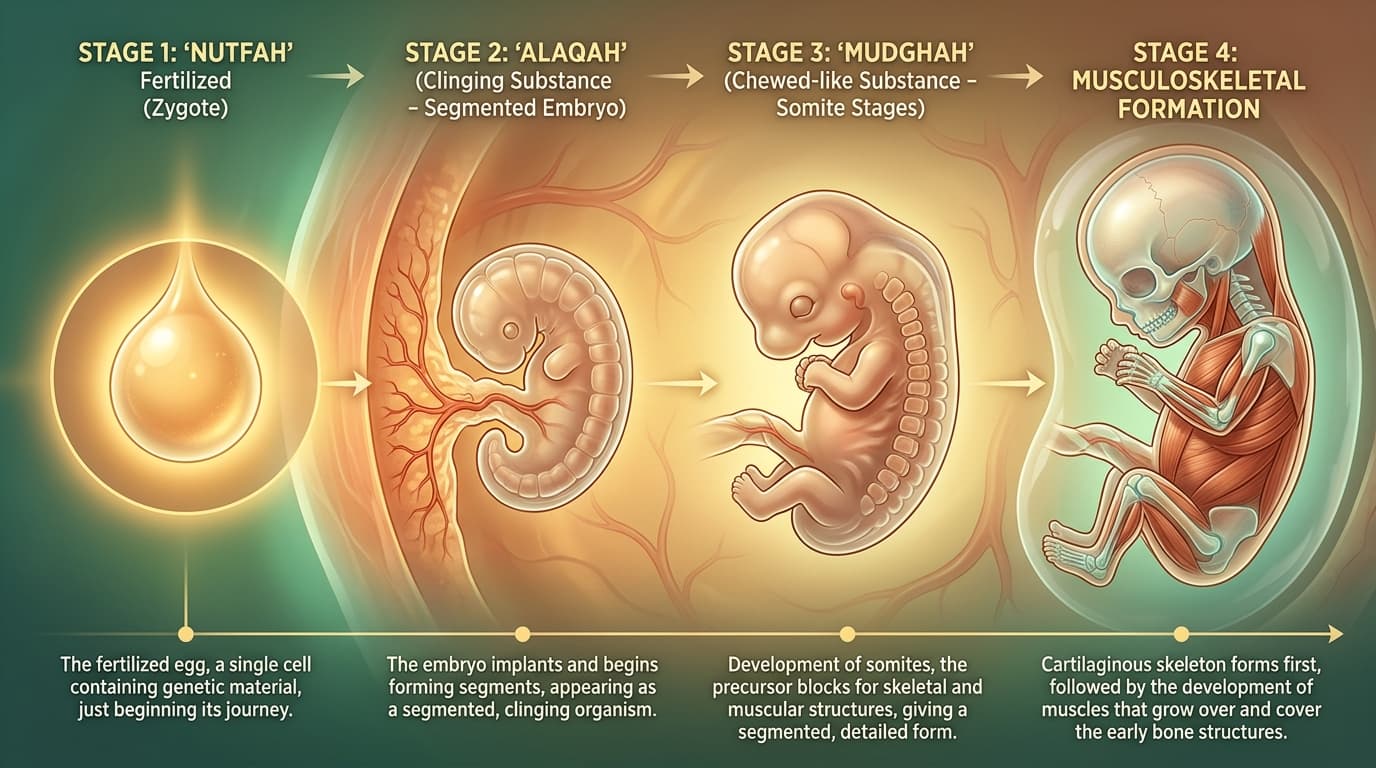
- Phase 1 (Nutfah Amshaj — Weeks 1-2): The fusion of male and female fluids creates the single-cell zygote (Khalq), followed immediately by genetic programming (Taqdir) including sex determination via the sperm's X/Y chromosome, before embedding securely in the uterine wall like a seed in fertile soil (Harth).
- Phase 2 ('Alaqah — Days 15-24): The Arabic word 'Alaqah has three precise meanings that each describe the 3-week-old embryo with uncanny accuracy: (1) a clinging/suspended structure attached by the connecting stalk, (2) an elongated body visually resembling a freshwater leech, and (3) a dark blood clot appearance due to early blood islands in closed primitive vessels.
- Phase 2 (Mudghah — Days 24-40): Translates as 'chewed-like lump' or bite-sized piece (~1 cm). Mesodermal somite blocks develop along the embryo's back, creating distinct ribbed furrows that remarkably resemble the impression of teeth marks on a chewed substance.
- Phase 2 ('Izam & Lahm — Weeks 7-8): Cartilaginous skeleton centers form around day 42 (as corroborated in Sahih Muslim's 42-day Hadith), followed immediately by myogenesis—where muscles wrap around and 'clothe' the skeletal framework, enabling initial movements.
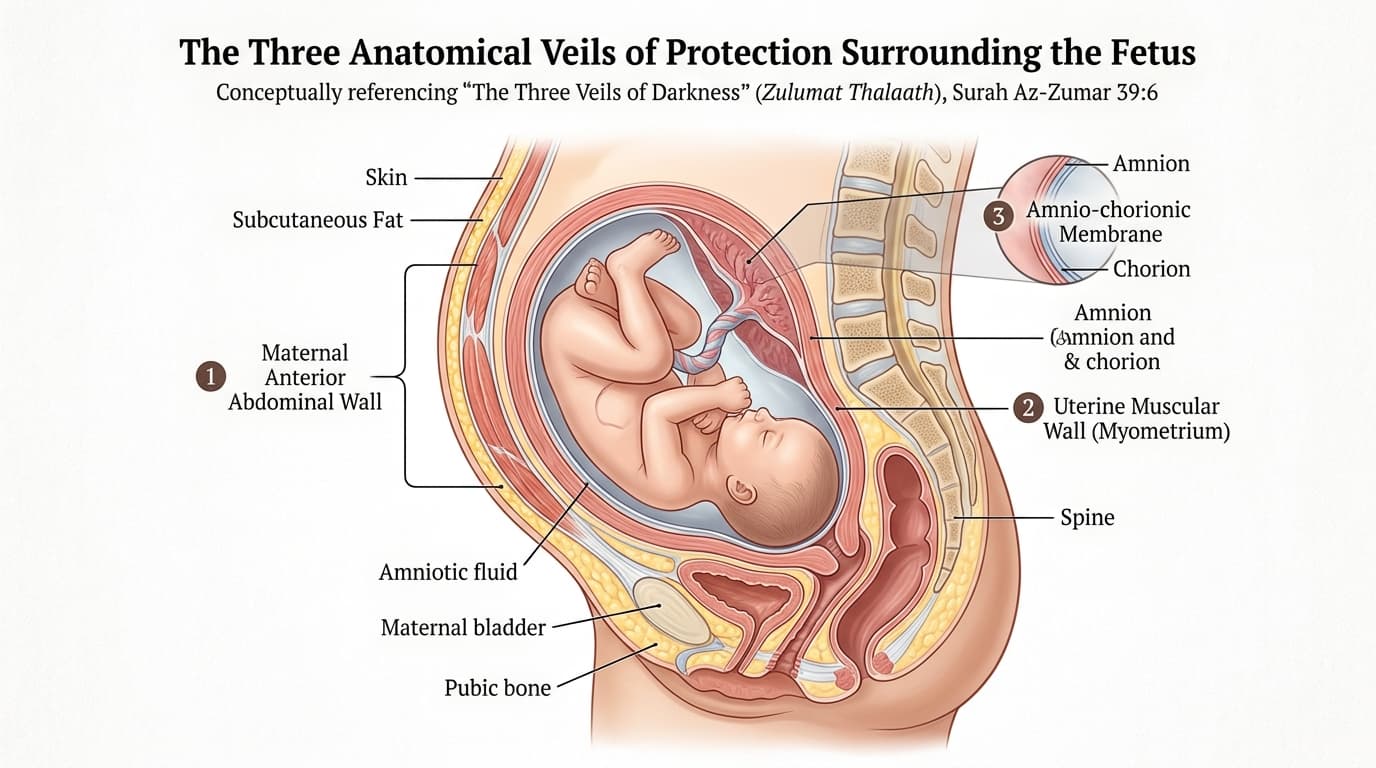
- The 3 Veils of Darkness (Surah 39:6): Modern obstetrics and anatomy identify the three concentric layers shielding the unborn child: the maternal abdominal wall, the uterine muscular wall (myometrium), and the amnio-chorionic sac.
- Medical Consensus: World-renowned embryologists including Dr. Keith L. Moore and Dr. E. Marshall Johnson confirmed that these developmental classifications could not have been known in the 7th century without divine revelation.
The 7 Chronological Stages of Human Embryology
In Surah Al-Mu’minun (23:12–14), the Quran outlines the complete intrauterine journey of human creation through seven distinct, descriptive milestones. Unlike modern numerical staging systems (such as Carnegie Stages), the Quranic terms visually describe the exact physical shape and biological behavior of the developing child:
Nutfah Amshaj (Mingled Drop of Fluids)
Zygote & ChromosomesA single sperm cell from the male fuses with the ovum from the female in the Fallopian tube. Modern genetics confirms that 23 paternal chromosomes mix with 23 maternal chromosomes in a mingled fluid (Amshaj) to formulate the single-cell diploid genome.
Khalq & Taqdir (Creation & Genetic Programming)
DNA Blueprint & Sex DeterminationThe zygote undergoes rapid mitotic cleavage into a morula and blastocyst. At this moment, Taqdir (genetic programming) permanently locks eye color, hair texture, blood group, and biological sex determined exclusively by the father's X or Y chromosome (Surah 53:45–46).
Harth in Qararin Makeen (Plowed Soil & Safe Abode)
Endometrial EmbeddingThe blastocyst burrows deep into the vascular mucous lining of the maternal uterus (endometrium). The Quran compares this maternal bed to 'Harth' (fertile, cultivated soil) where a seed takes root to draw nourishment and anchor securely.
'Alaqah (Clinging Clot & Leech-Like Form)
Leech Shape & Primitive BloodPossesses three remarkable literal meanings verified by anatomists: (1) An embryo suspended from the uterine wall via the connecting stalk, (2) An elongated curved dorsal shape physically resembling a freshwater leech, and (3) Internal blood pools in closed capillaries resembling a dark blood clot.
Mudghah (Chewed-Like Lump with Teeth Marks)
Somitogenesis & SegmentationThe embryo reaches ~1 cm (a bite-sized mouthful). Paired mesodermal somite blocks emerge along the neural axis, creating regular indentations that look identical to teeth impressions in chewed gum. Tissues are partially differentiated (Mukhalliqah) and partially undifferentiated.
'Izam & Lahm (Cartilage Skeleton & Muscular Clothing)
Chondrogenesis & MyogenesisPrimary cartilaginous bone models form around Day 42 (as noted in Sahih Muslim's 42-day Hadith). Soon after, myoblasts migrate around the skeletal scaffold to 'clothe' the bones with muscle tissue (Lahm), initiating initial reflex twitches.
Nash'ah Khalqan Akhar (Metamorphosis into Another Creation)
Fetus, Hearing, Sight & ViabilityThe embryo graduates into a fetus. Recognizable human facial proportions emerge, internal organs mature, sensory faculties develop in precise Quranic order (hearing first, then sight), and the viable infant prepares for birth.
The Three Veils of Darkness (Zulumāt Thalāth)
In Surah Az-Zumar (39:6), Allah says: “He creates you in the wombs of your mothers, creation after creation, in three veils of darkness (fī ẓulumātin thalāth).” Modern obstetrics and gross anatomical dissection establish that the fetus is insulated from external light, kinetic shock, and bacterial pathogens by three concentric physical walls:
Abdominal Wall (Jidār al-Baṭn)
Composed of maternal epidermis, subcutaneous adipose fat layer, rectus abdominis muscle, transversalis fascia, and parietal peritoneum. This thick multi-layered wall blocks all visible ambient light and protects against physical trauma.
Uterine Wall (Jidār al-Raḥim)
The powerful smooth muscle wall of the womb (myometrium) and the vascular decidualized inner endometrium. It expands throughout gestation while maintaining a heavy, blood-rich barrier that dampens acoustic vibrations and light.
Amnio-Chorionic Membrane (Ghashā’ al-Amniyūn)
The fused amnion and chorion membranes enclosing the amniotic fluid. This sterile fluid cushion provides neutral buoyancy, stabilizes fetal temperature, prevents adhesion to uterine tissues, and provides complete optical darkness.
Ancient Scientific Fallacies vs. 7th-Century Quranic Revelation
Critics often claim ancient religious texts merely reflected surrounding folklore. A rigorous comparison between the reigning doctrines of antiquity (Aristotle, Galen, 17th-century European science) and the Quran reveals that the Quran actively overturned the major fallacies of its era:
| Embryological Question | Ancient Beliefs (Aristotle, Galen, Homunculus) | Holy Quran (7th Century Revelation) | Modern Medical Science (20th–21st c.) |
|---|---|---|---|
| Origin of the Embryo | Aristotle: Semen acts like rennet curdling maternal menstrual blood into cheese. Ovum plays no genetic role. | Nutfah Amshaj: Formed from a mingled drop combining male and female fluids. Menstrual blood ceases and is not the material. | Zygote forms from the union of male sperm (23 chromosomes) and female ovum (23 chromosomes). |
| Morphology / Preformation | 17th c. Homunculus: Fully formed miniature human inside the sperm head that merely inflates in size. | Atwār (Phases):Stepwise transformation passing through distinct shapes: drop → clinging leech → chewed lump → skeleton → muscle. | Epigenesis: The embryo morphologically differentiates through specialized embryonic stages (Carnegie Stages). |
| Sex Determination | Attributed to womb warmth, wind direction during coitus, or whether sperm originated from the left or right testicle. | Surah 53:45–46: Male and female sexes are created strictly from the male fluid drop (Nutfah) when emitted. | The father’s sperm cell dictates biological sex: an X-sperm yields female (XX), a Y-sperm yields male (XY). |
| Bones & Muscles | Galen: Believed all organs, skeleton, and flesh formed simultaneously out of semen. | Surah 23:14: Made the chewed lump into bones (‘Izam), then clothed (Kasauna) the bones with flesh/muscle (Lahm). | Chondrification of the cartilaginous skeleton occurs first, followed immediately by myogenesis wrapping around bones. |
The 42-Night (6-Week) Milestone in Sahih Muslim
Prophetic Tradition • Sahih Muslim, Kitab Al-Qadar, Hadith 2645
“When forty-two nights pass after the drop is in the womb, Allah sends an angel to give it form, fashioning its hearing, its sight, its skin, its flesh, and its bones. Then the angel says: ‘O Lord, male or female?’ and your Lord decrees whatever He wills...”
Prior to Day 42, the embryo resembles other mammalian embryos. Exactly at 6 weeks, branchial arches merge to form distinct human facial contours.
Internal ear vesicles and optic retinal pigments appear simultaneously at Day 42, precisely as stated in the Hadith: “its hearing and sight”.
The mesenchymal model begins cartilaginous chondrification at Day 42, establishing the primary limb bones and vertebral column.
Before Day 42, the genital tubercle is indifferent. Only after Day 42 do morphological sex differences begin differentiating.
Statements from International Authorities in Anatomy & Embryology
“It has been a great pleasure for me to help clarify statements in the Quran about human development. It is clear to me that these statements must have come to Muhammad from God, because almost all of this knowledge was not discovered until many centuries later. This proves to me that Muhammad must have been a messenger of God.”
Dr. Keith L. Moore, Ph.D., F.I.A.C.
Professor Emeritus of Anatomy & Cell Biology, University of Toronto; Author of The Developing Human; Former President of Canadian Association of Anatomists.
“The Quran describes not only the development of external form, but emphasizes the internal stages, the stages inside the embryo, of its creation and development, emphasizing major events recognized by contemporary science... I see nothing here in conflict with the concept that divine intervention was involved.”
Dr. E. Marshall Johnson, Ph.D.
Professor Emeritus of Anatomy & Developmental Biology; Director of Daniel Baugh Institute, Thomas Jefferson University, Philadelphia, USA.
Introduction: The Mystery of the Unborn Child & The Overturning of Ancient Myths
Phase 1: Nutfah Amshaj — Fertilization, Genetic Code & Implantation (Weeks 1 to 2)
Phase 2: The 'Alaqah Epoch (Days 15–24) — The Clinging, Leech-Like Clot
Phase 2: The Mudghah Epoch (Days 24–40) — The 'Chewed Lump' & The Somite Teeth Marks
Phase 2: 'Izam & Lahm (Weeks 7–8) — Bone Architecture and the Clothing of Muscle
Phase 3: Al-Nash'ah — The Fetal Epoch, Human Modeling & Uterine Incubation (Weeks 9–40)
The Three Veils of Darkness (Zulumat Thalaath): The Anatomical Shields of the Womb
Scientific Evaluation: What World-Class Anatomists Discovered
References & Academic Bibliography
7th-Century Historical & Epistemological Context
In 7th-century Arabia, optical microscopes, histological fixatives, and cellular embryology were non-existent. Bedouin desert dwellers had no scientific laboratory equipment. The Quran narrated the chronological metamorphosis of the human embryo with precise morphological descriptors ('Alaqah, Mudghah, 'Izam, Lahm) that top anatomists like Dr. Keith L. Moore and Dr. E. Marshall Johnson recognized as impossible to have originated from human observation in antiquity.
Frequently Asked Questions on Embryology in the Quran
Q1.What does the Arabic word 'Alaqah' mean in the context of embryology?
In classical Arabic, 'Alaqah (عَلَقَة) carries three distinct meanings, all of which apply with remarkable scientific accuracy to the human embryo at 15–24 days: (1) A clinging or suspended structure, describing how the blastocyst attaches to the uterine endometrium via the connecting stalk (future umbilical cord); (2) A leech-like structure, matching the curved dorsal shape and appearance of the embryo at 22–24 days which closely resembles the freshwater leech (Hirudo medicinalis); and (3) A blood clot, describing the closed internal cardiovascular loop where blood pools in embryonic vessels before full systemic circulation begins.
Q2.What are the 'Three Veils of Darkness' mentioned in Surah Az-Zumar (39:6)?
Surah Az-Zumar 39:6 states that God creates man in the wombs of mothers 'in three veils of darkness' (fī ẓulumātin thalāth). Modern obstetrics and anatomical science confirm three physical protective layers that shield the developing embryo from light, physical trauma, and temperature fluctuations: (1) The anterior abdominal wall of the mother, (2) The muscular uterine wall (myometrium and endometrium), and (3) The amnio-chorionic membrane containing the amniotic fluid sac surrounding the fetus.
Q3.What is the meaning of 'Mudghah' and why does it resemble a chewed substance?
The Arabic term 'Mudghah' (مُضْغَة) means a chewed substance, a piece of meat small enough to be chewed (approximately the size of a mouthful or bite), or something bearing teeth impressions. Around day 24 to 40, the human embryo develops paired mesodermal blocks called somites along its back, which will form the vertebral column and segmental musculature. These somites create regular, alternating grooves along the dorsal surface that physically look like teeth indentations in a piece of chewed gum. Furthermore, the Quran distinguishes between 'Mudghah Mukhalliqah' (differentiated tissue) and 'Ghayr Mukhalliqah' (undifferentiated tissue), precisely reflecting that somites differentiate while adjacent mesenchyme remains unspecialized.
Q4.How does modern science validate the 42-day milestone mentioned in the Hadith of Sahih Muslim?
In Sahih Muslim (Hadith 2645), the Prophet Muhammad (ﷺ) stated: 'When forty-two nights have passed over the drop, Allah sends an angel to shape it, creating its hearing, sight, skin, flesh, and bones...' In modern embryological staging (Carnegie Stages 17–18, occurring exactly at days 42–44), human embryo organogenesis reaches a transformative threshold: the facial branchial arches form recognizable human eye and ear placodes, the cartilaginous skeleton undergoes primary chondrogenesis, and the embryo visibly transitions into an undeniable human form.
Q5.Did the Quran borrow embryological knowledge from ancient Greek physicians like Aristotle or Galen?
No. Ancient Greek doctrines contained major biological errors that the Quran completely avoided. Aristotle (4th c. BCE) taught that the fetus was formed solely from male semen coagulating maternal menstrual blood (like rennet curdles cheese), completely ignoring the female ovum. Galen (2nd c. CE) claimed organs formed simultaneously from mixed fluids. In contrast, the Quran correctly stated that menstrual blood ceases during pregnancy (is harmful/impure for conception, Surah 2:222), that the child is formed from a 'mingled drop' (Nutfah Amshaj) combining both male and female genetic contributions, that the father's sperm determines biological sex (Surah 53:45–46), and that development proceeds through distinct epigenetic stages (Atwar).
Q6.What was Dr. Keith L. Moore's evaluation of the Quran's embryology descriptions?
Dr. Keith L. Moore was Professor Emeritus of Anatomy and Cell Biology at the University of Toronto, former President of the Canadian Association of Anatomists, and author of the gold-standard medical textbook 'The Developing Human: Clinically Oriented Embryology'. After analyzing the Quranic terminology in the 1980s, Dr. Moore concluded that the Quranic classifications of embryonic stages ('Alaqah, Mudghah, 'Izam, Lahm) provide a superior, descriptive morphological system that was impossible to have been known in the 7th century without divine inspiration, noting: 'It is clear to me that these statements must have come to Muhammad from God, because almost all of this knowledge was not discovered until many centuries later.'
References & External Peer-Reviewed Literature
Human Embryology and the Holy Quran: An Overview
Dr. Sabiha Saadat, Department of Anatomy, College of Medicine, Qassim University. Published in International Journal of Health Sciences (Qassim), 2009 Jan; 3(1): 103–109.
Medical & Islamic Secondary References:
- Moore, Keith L. & Azzindani, Abdul-Majeed (1983). The Developing Human: Clinically Oriented Embryology with Islamic Additions (3rd ed.). Saunders / Dar Al-Qalam, Jeddah.
- Moore, Keith L., Persaud, T.V.N., & Torchia, Mark G. (2008). The Developing Human: Clinically Oriented Embryology (8th ed.). Saunders / Elsevier, Philadelphia. ISBN: 978-1-4160-3706-4.
- Johnson, E. Marshall (1982). Values and Ethics in the Natural Sciences: Embryology in the Quran. Daniel Baugh Institute of Anatomy, Thomas Jefferson University.
- Ibn Kathir, Ismail ibn Umar (774 AH / 1373 CE). Tafsir al-Qur’an al-‘Azim. Commentary on Surah Al-Mu’minun (23:12–14) and Surah Az-Zumar (39:6).
- Ibn Hajar al-Asqalani (852 AH / 1448 CE). Fath al-Bari fi Sharh Sahih al-Bukhari, Vol. 11. Refutation of Aristotelian menstrual coagulum theory.
- Sahih Muslim, Kitab Al-Qadar (The Book of Destiny), Hadith 2645: The 42-day morphological differentiation and organogenesis narrated by Hudhaifa ibn Usaid.
Found this research enlightening?
Share this research article with family, students, and seekers of knowledge.