
Islamic Golden Age • Quranic Epistemology • Ibn al-Haytham, Al-Biruni & The Scientific Revolution
The Golden Age of Islamic Science: How the Holy Quran Inspired the World's Greatest Scientific Renaissance
An exhaustive historical and theological treatise documenting how the Holy Quran's explicit mandate for Tafakkur (rational contemplation) and Tadabbur (empirical investigation of nature) ignited the Islamic Golden Age (8th–14th centuries CE). Drawing directly from classical Sunni exegesis (Tafsir Sirat-ul-Jinan by Dawat-e-Islami, Tafsir Khaza'in al-Irfan, Tafsir Noor al-Irfan) and documented research (Ala Hazrat ki Sciency Afkar-o-Tahqeeqat by Maktaba-tul-Madinah), this treatise examines the foundational breakthroughs of history's foremost polymaths: Al-Hasan Ibn al-Haytham (the inception of the experimental scientific method & modern optics), Abu Rayhan Al-Biruni (calculating Earth's radius with 99.7% accuracy at Nandana), Abu Ali Ibn Sina (clinical trials, pharmacology, and quarantine in Al-Qanun fi al-Tibb), Abu al-Qasim Al-Zahrawi (the father of modern surgery and 200+ surgical instruments), Muhammad ibn Musa Al-Khwarizmi (the birth of algebra and algorithms), Ibn al-Nafis (the discovery of pulmonary blood transit), and Fatima al-Fihri (establishing the world's first university in 859 CE).
إِنَّ فِي خَلْقِ السَّمَاوَاتِ وَالْأَرْضِ وَاخْتِلَافِ اللَّيْلِ وَالنَّهَارِ لَآيَاتٍ لِّأُولِي الْأَلْبَابِ الَّذِينَ يَذْكُرُونَ اللَّهَ قِيَامًا وَقُعُودًا وَعَلَىٰ جُنُوبِهِمْ وَيَتَفَكَّرُونَ فِي خَلْقِ السَّمَاوَاتِ وَالْأَرْضِ رَبَّنَا مَا خَلَقْتَ هَٰذَا بَاطِلًا سُبْحَانَكَ فَقِنَا عَذَابَ النَّارِ
Quranic Translation
“Indeed, in the creation of the heavens and the earth, and the alternation of night and day, are signs for those of understanding—who remember Allah while standing, sitting, and lying on their sides, and contemplate the creation of the heavens and the earth, [saying]: 'Our Lord! You did not create this without purpose; glory be to You! So protect us from the punishment of the Fire.' (Surah Al-Imran 3:190–191 — Kanzul Iman)”
Key Scientific Inventions & Quranic Epistemology At A Glance
- The Quranic Driver for Empirical Science: The Holy Quran commands humanity in over 750 verses to contemplate, observe, and investigate the laws of nature (Tafakkur & Tadabbur). As documented in Tafsir Sirat-ul-Jinan (Dawat-e-Islami), observation of creation is an established avenue of achieving divine awareness (Ma'rifat-e-Ilahi).
- Invention of the Modern Scientific Method: Al-Hasan Ibn al-Haytham (Alhazen, 965–1040 CE) founded the modern experimental scientific method in his 'Kitab al-Manazir' (Book of Optics), proving that light reflects into the eye, inventing the camera obscura, and insisting that hypotheses must be rigorously tested through repeatable empirical experiments.
- Trigonometric Geodesy of Al-Biruni: Abu Rayhan Al-Biruni (973–1050 CE) measured the radius of the Earth from the hill of Nandana (Punjab) using novel spherical trigonometry and dip-angle measurements, reaching 6,335.72 km—within an astonishing 0.25% of modern satellite measurements (6,371 km).
- Foundations of Modern Clinical Medicine: Abu Ali Ibn Sina (Avicenna, 980–1037 CE) codified pharmacology, symptomology, and clinical quarantine (Al-Arba'iniya) in 'The Canon of Medicine' (Al-Qanun fi al-Tibb), which remained the standard medical textbook in European universities for more than five centuries.
- The Father of Operative Surgery: Abu al-Qasim Al-Zahrawi (Abulcasis, 936–1013 CE) pioneered over 200 surgical instruments—including scalpels, forceps, bone saws, and catgut dissolvable sutures—in his 30-volume medical encyclopedia 'Kitab al-Tasrif'.
- The Birth of Algebra and Algorithms: Muhammad ibn Musa Al-Khwarizmi (c. 780–850 CE) developed algebra ('Al-Jabr') to solve real-world problems such as Quranic inheritance distribution (Fara'id) and civil engineering, introducing the zero (Sifr) and the decimal system to the world.
- Pioneering Social Institutions: Islamic civilization established the world's first degree-granting university (University of al-Qarawiyyin, founded by Fatima al-Fihri in 859 CE) and the world's first modern teaching hospitals (Bimaristans), providing free, comprehensive inpatient healthcare with specialized wards and clinical trials.
- Harmony of Reason and Revelation in Sunni Creed: As expounded in Dawat-e-Islami's research 'Ala Hazrat ki Sciency Afkar-o-Tahqeeqat', orthodox Ahle Sunnat theology demonstrates that scientific inquiry explores secondary physical mechanisms (Asbab), while faith acknowledges the Supreme Creator (Musabbib al-Asbab), establishing eternal harmony between sound intellect and divine revelation.
Pioneers of the Scientific Renaissance
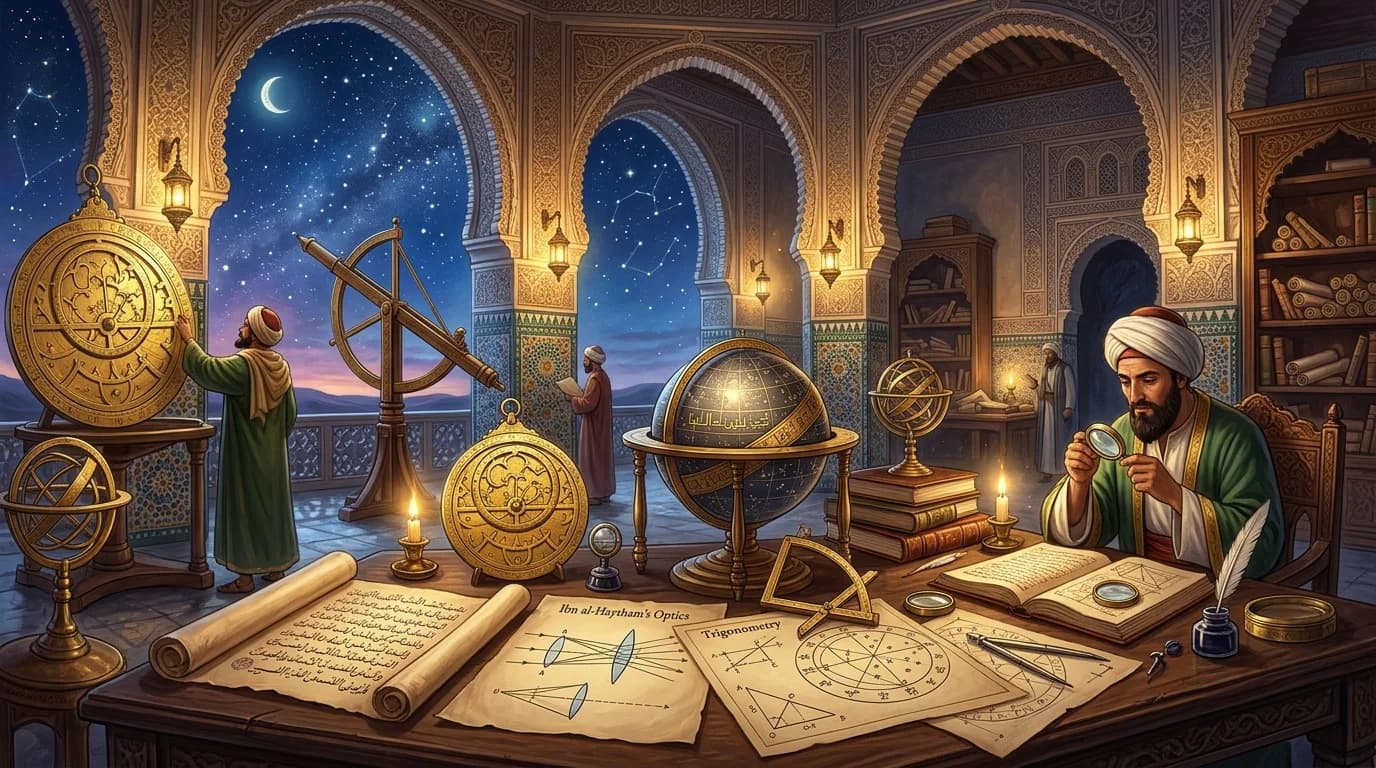
Inspired by the Quranic command of Tafakkur(deep rational contemplation), Muslim polymaths founded the empirical scientific method, modern surgery, algebra, geodesy, and the world's first universities centuries before the Western Renaissance.
The Golden Age of Islamic Science: How the Holy Quran Inspired the World's Greatest Scientific Renaissance
Exhaustive scholarly treatise anchored in Tafsir Sirat-ul-Jinan (Dawat-e-Islami), Tafsir Khaza'in al-Irfan, and primary historical manuscripts from Cairo, Baghdad, and Cordoba.
Al-Hasan Ibn al-Haytham
الحسن ابن الهيثم
Optics, Physics & Scientific Method
Invented the modern experimental scientific method (controlled hypothesis testing) and proved intromission theory of vision. Invented the Camera Obscura (Al-Bayt al-Muzlim), creating the physical basis for cameras, microscopes, and telescopes.
Abu Rayhan Al-Biruni
أبو الريحان البيروني
Astronomy, Geodesy & Trigonometry
Calculated the radius and circumference of the Earth from the hill of Nandana with an astonishing 99.7% accuracy (6,335.72 km vs modern 6,371.00 km) using novel spherical trigonometry and dip-angle measurements.
Abu Ali Ibn Sina
أبو علي الحسين بن عبد الله بن سينا
Clinical Medicine, Pharmacology & Pathology
Authored Europe's standard medical textbook for 500+ years. Pioneered clinical quarantine (Al-Arba'iniya - 40 days of isolation to halt contagion), systematic double-blind drug testing protocols, and discovered airborne disease transmission.
Abu al-Qasim Al-Zahrawi
أبو القاسم خلف بن العباس الزهراوي
Operative Surgery & Medical Devices
The Father of Modern Operative Surgery. Invented over 200 surgical instruments (forceps, scalpels, bone saws, syringes, speculums) and pioneered dissolvable internal catgut sutures from sheep intestines.
Muhammad ibn Musa Al-Khwarizmi
محمد بن موسى الخوارزمي
Algebra, Algorithms & Astronomy
Created 'Algebra' (Al-Jabr) as an independent science. Introduced the Hindu-Arabic decimal positional system and Zero (Sifr) to the world. His Latinized name gave humanity the word 'Algorithm'.
Ala al-Din Ibn al-Nafis
علاء الدين علي بن أبي الحزم القرشي (ابن النفيس)
Cardiology, Physiology & Shafi'i Fiqh
Discovered the pulmonary circulation of blood (blood transit between heart and lungs for oxygenation), refuting Galen 300+ years before William Harvey and Michael Servetus.
Fatima al-Fihri
فاطمة بنت محمد الفهرية
Education, Architecture & Public Institutions
Utilized her entire personal inheritance to establish the world's oldest continually operating university granting degrees, recognized by UNESCO and Guinness World Records.
The Islamic Bimaristan Network
شبكة البيمارستانات الإسلامية
Public Health, Teaching Hospitals & Medical Ethics
Pioneered the world's first modern teaching hospitals with specialized male/female wards, separate contagious disease units, medical licensing exams, inpatient pharmacies, and 100% free treatment for all humans regardless of faith.
Al-Hasan Ibn al-Haytham
(Known in the West as Alhazen)الحسن ابن الهيثم
Kitab al-Manazir (Book of Optics, 1021 CE)
Contemplating the divine reality of light as described in Surah An-Nur and the command to investigate the heavens with critical, error-tested empirical rigor.
Invented the modern experimental scientific method (controlled hypothesis testing) and proved intromission theory of vision. Invented the Camera Obscura (Al-Bayt al-Muzlim), creating the physical basis for cameras, microscopes, and telescopes.
“The duty of the man who investigates the writings of scientists is to make himself an enemy of all that he reads, and attack it from every side.”
1. The Quranic Epistemological Engine: Tafakkur, Tadabbur, and the Signs in the Horizons
2. Al-Hasan Ibn al-Haytham (Alhazen): The Inception of the Modern Experimental Method
3. Abu Rayhan Al-Biruni: Geodesy and Measuring the Earth's Radius at Nandana
4. Abu Ali Ibn Sina (Avicenna) & Ibn al-Nafis: The Architecture of Clinical Medicine
5. Abu al-Qasim Al-Zahrawi (Abulcasis): The Father of Operative Surgery
6. Al-Khwarizmi: The Genesis of Algebra and Algorithmic Thought
7. The Institutional Revolution: Bimaristans and the World's First University
8. The Ahle Sunnat Perspective: The Eternal Harmony of Revelation and Reason
7th-Century Historical & Epistemological Context
During the European Dark Ages, Islamic civilization—spanning from Cordoba and Fez to Cairo, Baghdad, Isfahan, and Samarkand—fostered a global knowledge revolution. The Holy Quran established knowledge ('Ilm) and natural observation (Tafakkur) as religious duties. Caliphs and scholars established the House of Wisdom (Bayt al-Hikmah) in Baghdad, the world's first degree-granting university (University of al-Qarawiyyin, 859 CE), and the world's first teaching hospitals (Bimaristans) providing free, state-of-the-art healthcare to all citizens regardless of creed. Classical Ahle Sunnat authorities, including Sadrul Afazil Allama Naeemuddin Muradabadi, Mufti Ahmad Yar Khan Naeemi, and Dawat-e-Islami scholars (Tafsir Sirat-ul-Jinan), demonstrate that Islam never experienced a 'Galileo-style' conflict between faith and science; rather, science was celebrated as the systematic deciphering of Allah Almighty's cosmic signs (Ayat).
Frequently Asked Questions on the Islamic Golden Age & Quranic Science
Q1.How did the Holy Quran inspire the scientific achievements of the Islamic Golden Age?
The Holy Quran contains over 750 verses commanding humanity to observe, reflect, and investigate creation (Tafakkur and Tadabbur). As documented in Tafsir Sirat-ul-Jinan (Dawat-e-Islami), early Muslim scholars pursued natural sciences not as a secular hobby, but as a direct act of divine cognition (Ma'rifat-e-Ilahi) to appreciate the wisdom, design, and omnipotence of Allah Almighty.
Q2.Who formulated the modern empirical scientific method?
Al-Hasan Ibn al-Haytham (Alhazen, 965–1040 CE) formulated the modern experimental scientific method in his 7-volume masterwork 'Kitab al-Manazir' (Book of Optics) in 1021 CE—more than five centuries before Francis Bacon or René Descartes. He proved vision occurs by light entering the eye, constructed the Camera Obscura, and established the mandatory protocol of hypothesis testing through repeatable controlled experiments.
Q3.How did Abu Rayhan Al-Biruni measure the Earth's radius in 1030 CE?
Standing atop the hill of Nandana (Punjab), Al-Biruni measured the dip angle of the horizon using a precision astrolabe and spherical trigonometry. He determined the Earth's radius to be 6,335.72 km—within an astonishing 0.25% of modern satellite measurements (6,371.00 km)—an achievement unmatched in Europe for over 700 years.
Q4.What surgical instruments and methods did Abu al-Qasim Al-Zahrawi invent?
Abu al-Qasim Al-Zahrawi (Abulcasis, 936–1013 CE) authored the 30-volume 'Kitab al-Tasrif', the world's first illustrated surgical encyclopedia. He personally designed over 200 surgical instruments—including scalpels, forceps, bone saws, and lithotrites—and pioneered the use of catgut dissolvable internal sutures from sheep submucosa, which revolutionized modern operative surgery.
Q5.Did Islam ever experience a conflict between science and religion like medieval Europe?
No. As explained by the research scholars of Dawat-e-Islami in 'Ala Hazrat ki Sciency Afkar-o-Tahqeeqat', orthodox Sunni creed (Ahle Sunnat wa Jama'at) maintains eternal harmony between reason and revelation. The Quran is the Recited Book of God (Kitab at-Tadwin), while the Universe is the Created Book of God (Kitab at-Takwin). Science studies secondary causes (Asbab), while faith honors the Supreme Creator (Musabbib al-Asbab).
Q6.What was the world's first degree-granting university?
The University of al-Qarawiyyin, founded in 859 CE in Fez, Morocco by a devout Muslim woman, Fatima al-Fihri. Both UNESCO and Guinness World Records officially recognize it as the oldest continuously operating higher educational institution conferring academic degrees in the world.
Q7.How did Ibn Sina's 'The Canon of Medicine' revolutionize healthcare?
Abu Ali Ibn Sina (Avicenna, 980–1037 CE) codified pharmacology, diagnostics, and clinical quarantine (Al-Arba'iniya) in 'Al-Qanun fi al-Tibb'. He established the world's first standardized rules for human drug trials. Translated into Latin, 'The Canon' served as the mandatory core curriculum in European medical schools for over 500 years.
Q8.What was the Islamic Bimaristan system?
The Bimaristan was the world's first modern public teaching hospital system. In accordance with Quranic charity, Bimaristans (such as Al-Mansuri in Cairo and Al-Nuri in Damascus) provided comprehensive, state-funded, 100% free healthcare to all citizens regardless of wealth or religion, featuring specialized wards, pharmacies, psychiatric care, and physician licensing.
References & External Peer-Reviewed Literature
Tafsir Sirat-ul-Jinan & ‘Ala Hazrat ki Sciency Afkar-o-Tahqeeqat
Mufti Muhammad Qasim Qadri & Majlis Al-Madina-tul-Ilmiyyah. Published by Maktaba-tul-Madinah / Dawat-e-Islami, Karachi. Exposition of Quranic Tafakkur, cosmic signs, and the scientific treatises of Imam Ahmad Raza Khan Bareilvi.
Primary Historical & Scientific Treatises:
- Al-Hasan Ibn al-Haytham (1021 CE). Kitab al-Manazir (Book of Optics). 7 Volumes. The empirical foundation of the modern scientific method, refraction, reflection, and the camera obscura.
- Abu Rayhan Al-Biruni (1030 CE). Al-Qanun al-Mas’udi fi al-Hay’ah wan-Nujum & Tahqiq ma li-l-Hind. Trigonometric geodesy and calculation of the Earth’s radius at Nandana.
- Abu Ali Ibn Sina (Avicenna) (1025 CE). Al-Qanun fi al-Tibb (The Canon of Medicine). 5 Volumes. Standard textbook in European universities for over five centuries.
- Abu al-Qasim Al-Zahrawi (Abulcasis) (1000 CE). Kitab al-Tasrif li-man ‘Ajiza ‘an al-Ta’lif(Volume 30: On Surgery and Instruments). The world’s first illustrated surgical compendium.
- Muhammad ibn Musa Al-Khwarizmi (820 CE). Al-Kitab al-Mukhtasar fi Hisab al-Jabr wal-Muqabala. The foundation of algebra, algorithms, and Hindu-Arabic numerals.
- Ala al-Din Ibn al-Nafis (1242 CE). Sharh Tashrih al-Qanun. Discovery of the pulmonary transit of blood between heart and lungs.
- Ala Hazrat Imam Ahmad Raza Khan Bareilvi (1340 AH / 1921 CE). Al-Fawz al-Mubin fi Radd Harakat al-Ard & Al-Kalimatul Mulhimah fi al-Hikmatil Muhkamah.
- UNESCO & Guinness World Records. Official registration of the University of al-Qarawiyyin (founded 859 CE by Fatima al-Fihri) as the world’s oldest continuously operating degree-granting university.
Found this research enlightening?
Share this research article with family, students, and seekers of knowledge.
Explore More Science & Quran Articles
Tabut-e-Sakeena (The Ark of the Covenant): The Complete Authentic Sunni Treatise from the Quran, Hadith, and Islamic History
An exhaustive, authentic Sunni scholarly exposition on Tabut-e-Sakeena (The Ark of the Covenant / تابوتِ سکینہ) according to Surah Al-Baqarah (2:248), classical Tafsir literature (Tafsir Khaza'in al-'Irfan, Tafsir Noor al-Irfan, Tafsir al-Kabir, and Bahar-e-Shari'at), and Dawat-e-Islami research. This treatise examines the origin of the sacred chest from Sayyiduna Adam to Sayyiduna Musa (AS), the sacred prophetic relics (Tabarrukat) preserved inside, the spiritual nature of divine Sakeena (heavenly tranquility), the miraculous return of the Ark carried by angels for King Talut (Saul), the theological legitimacy of seeking blessings through holy relics (Tawassul & Tabarruk), modern Zionist archaeological tunnel digs beneath Al-Aqsa Mosque seeking its recovery, and the authentic prophetic traditions regarding its eschatological rediscovery by Sayyiduna Imam Mahdi (RA) from Lake Tiberias or Antioch.
Al-Masih ad-Dajjal (The False Messiah): The Complete Sunni Eschatological Treatise from the Quran, Sahih Hadith, and Classical Scholarship
An exhaustive, authentic Sunni scholarly exposition on Al-Masih ad-Dajjal (The Impostor / False Messiah) according to the Quran, Sahih Hadith literature, and the authoritative creed of Ahle Sunnat wa Jama'at as codified in Bahar-e-Shari'at and Fatawa Razawiyyah. This treatise examines his corporeal reality, physical markers, the eyewitness testimony of Sayyiduna Tamim ad-Dari (رضي الله عنه) and Al-Jassasah, supernatural illusions (Istidraj), the 40-day temporal deceleration and prayer jurisprudence, the impenetrable angelic barrier guarding Makkah and Madinah, his confrontation with the young believer, and his definitive termination by Sayyiduna Isa (Jesus) عليه السلام at the Gate of Ludd.
The Quadruple Symmetries of Surah Al-Ikhlas: Chromosomes, Gematria, and the Mathematics of Tawheed
A profound discovery into the multi-layered mathematical and biological architecture of Surah Al-Ikhlas: 47 letters divided into 23 before and 23 after the word 'Yalid' (matching the 23 paternal and 23 maternal chromosomes of human birth), 7 words on either side, identical 16-1-16 vowel balances, and an exact 198 = 198 Abjad gematria equilibrium.